Why Most AI Note Systems Fail: They Mix Sources, Summaries, And Claims
Most AI note systems fail because they collapse sources, summaries, claims, and generated output into one convenient pile. That feels fast today and becomes unreliable the moment you need to verify, revise, or reuse the knowledge.
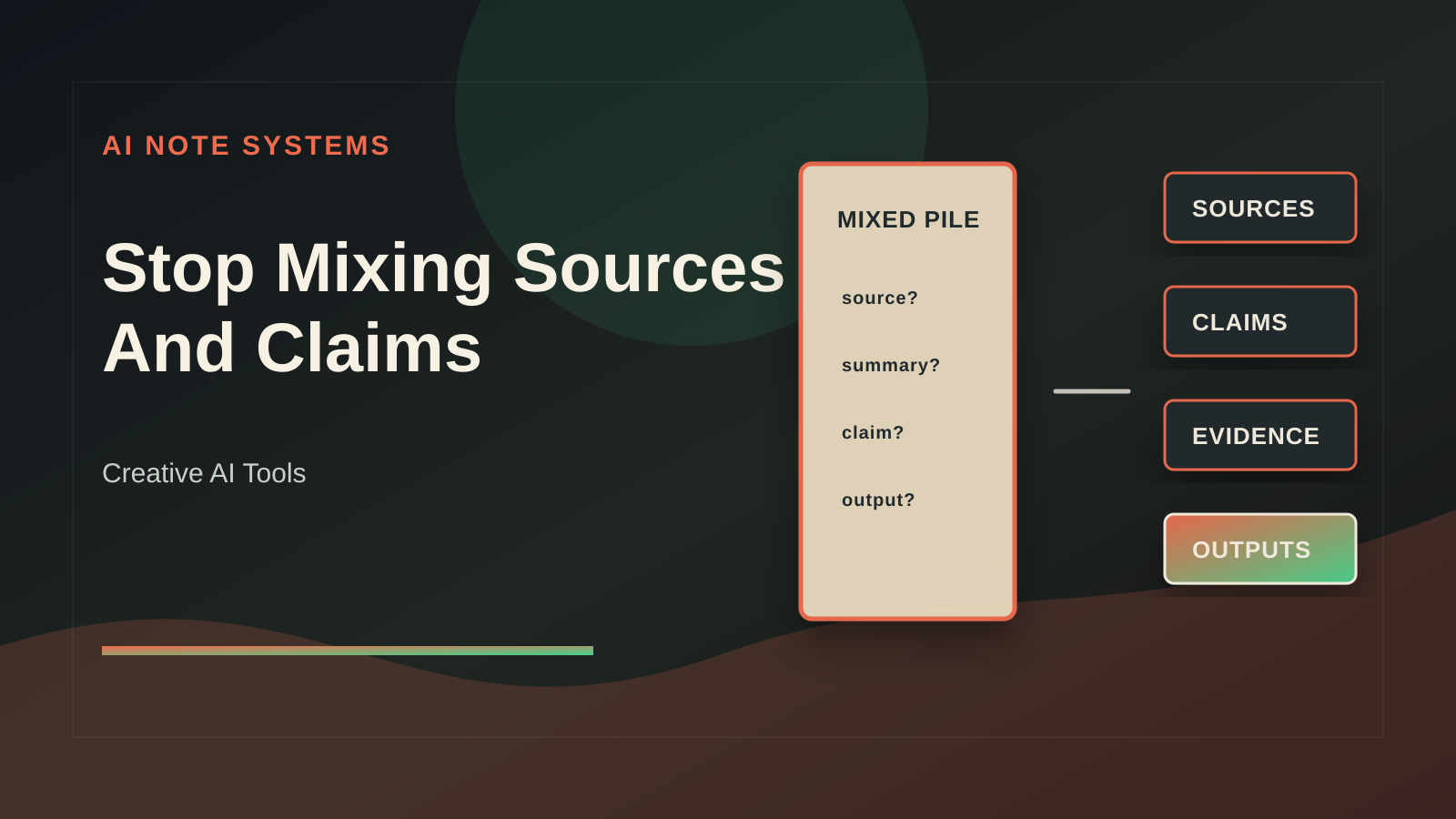
Most AI note systems are built around the wrong promise: dump everything in, ask questions later.
That sounds convenient. It is also how a knowledge base turns into soup.
The failure is not that the model cannot summarize. The failure is that the system forgets what kind of thing each note is. A source, a summary, a claim, a quote, a contradiction, a question, and a generated answer are not interchangeable. Treating them as one pile makes the demo feel magical and the archive feel haunted six weeks later.
When an AI note app collapses provenance, interpretation, and output into the same layer, it borrows trust from the source and spends it on the summary. That is the whole trick. It feels productive because the answer arrives quickly. It becomes unreliable because nobody can tell where the answer came from, what changed, or which parts were inferred.
The pile is convenient until you need to trust it
A messy AI note system usually starts innocently.
You import PDFs, transcripts, articles, meeting notes, screenshots, bookmarks, chat logs, and whatever else has been sitting in your digital junk drawer. The app chunks it. The model summarizes it. Search works well enough. A chat box appears. Suddenly your archive talks back.
For a while, this is delightful.
Then the real work begins.
You ask a question that matters. The answer cites something, sort of. It blends one transcript with one article and one old summary. It states a conclusion that sounds plausible. You cannot tell whether the conclusion was directly supported, lightly inferred, contradicted somewhere else, or invented during a previous summarization pass and then recycled as fact.
That is the moment the system stops being a second brain and becomes a rumor machine with folders.
Sources are not summaries
A source is evidence. It has an origin, a date, an author, a context, and a surface area larger than whatever the model noticed on the first pass.
A summary is interpretation. It is a compression of the source through a point of view, a prompt, a model, and a moment in time.
Both are useful. They should not be stored as if they are the same object.
If a transcript says, "The customer churned after implementation stalled," that is source material. If a summary says, "Implementation quality was the primary churn driver," that is a claim. It may be true. It may be directionally true. It may be a lazy compression that erases pricing, onboarding, support, and timing.
The distinction matters because future work depends on it. If you are writing, researching, building a product, training an agent, or making decisions, you need to know whether you are standing on evidence or standing on a paraphrase of evidence.
Claims need receipts
The smallest durable unit in an AI-maintained knowledge system is not the note. It is the claim-with-evidence.
A claim says something about the world:
- "Users do not trust AI summaries unless they can inspect the source."
- "Notebook-style tools are good for bounded research, but weak as durable operational memory."
- "Agents need compiled context files, but humans need inspectable markdown."
Each claim should point back to the source passages, conversations, files, or observations that support it. It should also have room for counterevidence.
This sounds slower than dumping everything into a chat app. It is slower at capture time. It is dramatically faster when the knowledge has to survive contact with reality.
A bare summary can answer, "What did this say?" A claim with evidence can answer better questions:
- Where did this belief come from?
- Is it still true?
- What would change my mind?
- Which source should I reread before publishing?
- Which agent output depends on this assumption?
That is knowledge management. The rest is autocomplete with a filing cabinet.
Generated output is cache, not truth
AI systems love producing polished text. That polished text is dangerous because it feels finished.
An agent-readable overview, a project brief, a blog outline, a comparison table, or a synthesized answer can be extremely useful. But it should be treated as compiled output, not ground truth. It is a cache generated from lower-level material.
Good caches are disposable. If the sources change, regenerate them. If the claims change, regenerate them. If a contradiction appears, regenerate them with the contradiction included.
Bad AI note systems treat generated prose as a new primary source. Then the next model reads that prose, summarizes it again, and compounds the compression. After a few loops, nobody knows whether the system remembers the original source or only remembers its own previous confidence.
That is how a knowledge base gets dumber while looking cleaner.
The practical structure is boring and that is why it works
The fix is not a more theatrical chat interface. The fix is separation.
A reliable AI note system needs distinct layers:
| Layer | Job |
|---|---|
| Sources | Preserve original material with provenance intact. |
| Extracted claims | Turn important observations into small, testable statements. |
| Evidence links | Connect each claim to source passages, files, or observations. |
| Questions | Track what is unresolved instead of laundering uncertainty into confidence. |
| Contradictions | Store conflicts explicitly so the system does not average them into nonsense. |
| Summaries | Compress sources for orientation, while staying subordinate to evidence. |
| Compiled outputs | Generate agent-friendly context, briefs, and indexes from the maintained layers. |
This is not glamorous. It is just honest plumbing.
The system should be able to say: here is the source, here is the summary, here is the claim we extracted, here is the evidence, here is what disagrees, and here is the current compiled view an agent can use.
That separation lets humans inspect the archive and lets agents work quickly without pretending the cache is the canon.
This is also the Seeds of Joy pattern-recognition seed. The pleasure is not in having more notes. It is in seeing the signal beneath the noise: which layer a thought belongs to, which claims are actually supported, and which confident paragraph is just a summary wearing a fake mustache.
The real enemy is premature synthesis
AI makes synthesis cheap, so people synthesize too early.
They summarize before preserving. They conclude before extracting. They publish an answer before tracking evidence. They let the interface hide the messy parts because the clean answer feels more useful.
But durable knowledge is allowed to be messy at the lower layers. In fact, it has to be. Sources disagree. People change their minds. Old assumptions expire. New evidence shows up. Some notes are half-baked. Some claims deserve to die.
A good AI note system should not sand all of that into a confident paragraph. It should keep the rough edges visible where they matter and compile clean views only when needed.
That is the difference between a system that helps you think and a system that helps you forget how you got there.
Build for the reread
The test for an AI note system is not whether it can impress you on day one. Most tools can do that now.
The test is whether it helps you six months later when you need to revisit a decision, defend a claim, update a page, brief an agent, or discover that your old conclusion was wrong.
If the system cannot tell sources from summaries, summaries from claims, claims from evidence, and generated output from maintained knowledge, it will fail that test.
Not because AI is useless. Because the structure is careless.
The better version is Bayesian updating made visible. New evidence should move the model. Old claims should get weaker, stronger, or retired. A note system that cannot update its beliefs is not a second brain. It is a scrapbook with a search bar.
The future of AI knowledge management is not one giant magic notebook. It is a disciplined workspace where raw material, interpretation, uncertainty, and output each have a place. Keep those layers separate, and agents can become genuinely useful maintainers of knowledge.
Mix them together, and you get convenience now, confusion later.