AI Should Sort the Crate, Not Replace the Ear
Timbre is an AI-assisted sample library for producers: it makes messy folders searchable, editable, and playable without pretending to replace taste.
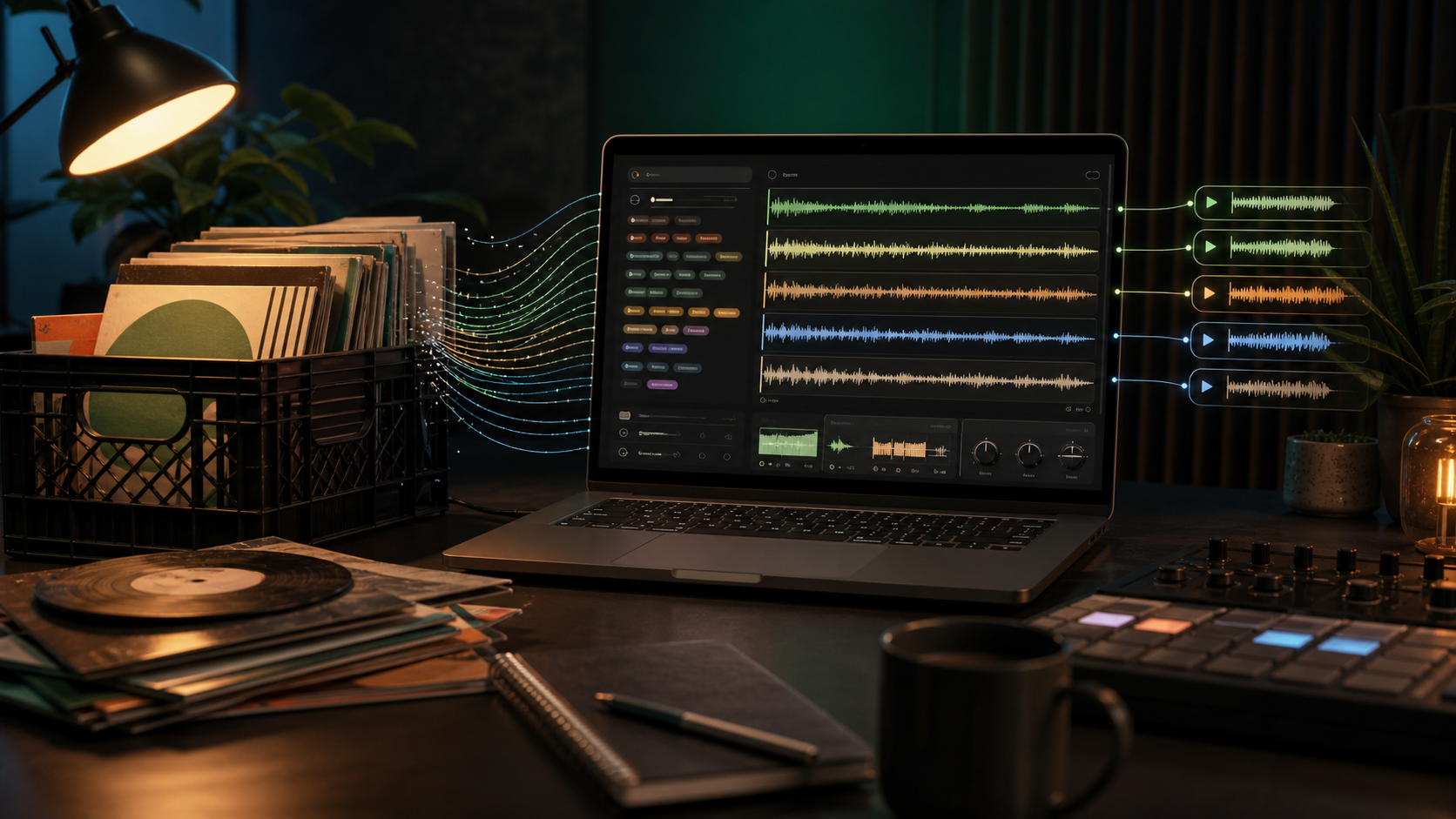
Most producers do not need another AI that promises to make music for them. They need their own sample library to stop acting like a locked storage unit.
Every producer knows the lie hidden inside a big sample folder: more sounds should mean more options. In practice, more sounds often means more friction.
You remember the idea of a sound. A dusty rimshot. A soft vocal chop. A field recording that had the right kind of room tone. But the file is buried three folders deep inside a pack named by someone who thought Audio_127_final_final.wav was acceptable behavior.
So you audition. You scroll. You break the spell. The beat was moving, and now you are doing clerical work.
A sound you cannot find quickly is not really in your library. It is just taking up disk space with better branding.
Timbre treats the library as part of the instrument
Timbre is an AI-assisted sample classifier, but that description is too small. The better description is this: Timbre listens to your archive and turns it into something you can ask musical questions of.
It reads what the file and folder names already know. Then it listens to the audio. It separates one-shots from loops and long recordings. It pulls out roles like kick, snare, bass, melodic, vocal, texture, ambience, and foley. It catches BPM, key, instruments, genres, energy, and producer notes when the right backend is available.
The ladder matters:
| Layer | What it does |
|---|---|
| Reads the label | Filename and folder clues still matter. Producers already encode context there. |
| Listens locally | Cheap local recognition handles the obvious stuff without making every hit expensive. |
| Escalates carefully | Heavier models are for ambiguity, not for turning a kick drum into a cloud bill. |
A good producer tool should not treat every sound like it needs a philosophical consultation from a hosted model. Some files just need to be recognized and put where your hands can reach them.
The important feature is not the AI. It is the override.
Timbre lets the machine do the first pass, then lets the producer correct it. Those edits are not disposable. They survive normal rescans.
That is the line between a toy and a tool. A toy says, "I analyzed your files, behold my answer." A tool says, "Here is a useful guess. Tell me where I am wrong, and I will remember."
The AI can sort the crate. The ear still decides what belongs in the set.
For producers, this is not a small detail. Your library is not a neutral database. It is taste, habit, memory, failed experiments, personal shortcuts, and sounds that only make sense because of how you use them.
A model might call something "ambient texture." You might know it as the thing that glues a chorus together when it is tucked under a pad and sidechained off the kick. Timbre has room for that human correction.
The workflow shift is simple
- Scan the messy archive. Let Timbre classify, cache, and index what is already on disk.
- Browse like a producer, not a sysadmin. Filter by role, instrument, BPM, key, collection, backend, and edited state.
- Preview before you commit. Waveforms and playback turn searching back into listening.
- Correct the machine where taste matters. Your edits become the trusted layer on top of the automated pass.
That turns sample management from folder diving into question asking: show me low-BPM percussion loops; find the edited vocal textures; pull every field recording; give me all the snares that might work around 92 BPM.
The quiet future of music AI may be less glamorous and more useful
The loudest AI music demos try to generate finished songs. Timbre is pointed at a less theatrical problem: how do you make a producer's own materials easier to reach?
That is a better place for AI to earn trust. Not by replacing the producer's taste, but by removing the drag around it. Not by pretending the machine has a better ear, but by giving the human ear a faster way back to the right sound.
Producers do not need infinite samples. Infinite samples are how the problem got this stupid in the first place. They need playable memory: a library that can listen, remember, and get out of the way when the beat starts talking.