Agent Wiki: The Evidence-Aware Second Brain for AI Agents
Agent Wiki is an Obsidian-compatible knowledge vault for AI agents: sources, claims, evidence, entities, concepts, questions, contradictions, and compiled caches stay separate enough to be trusted.
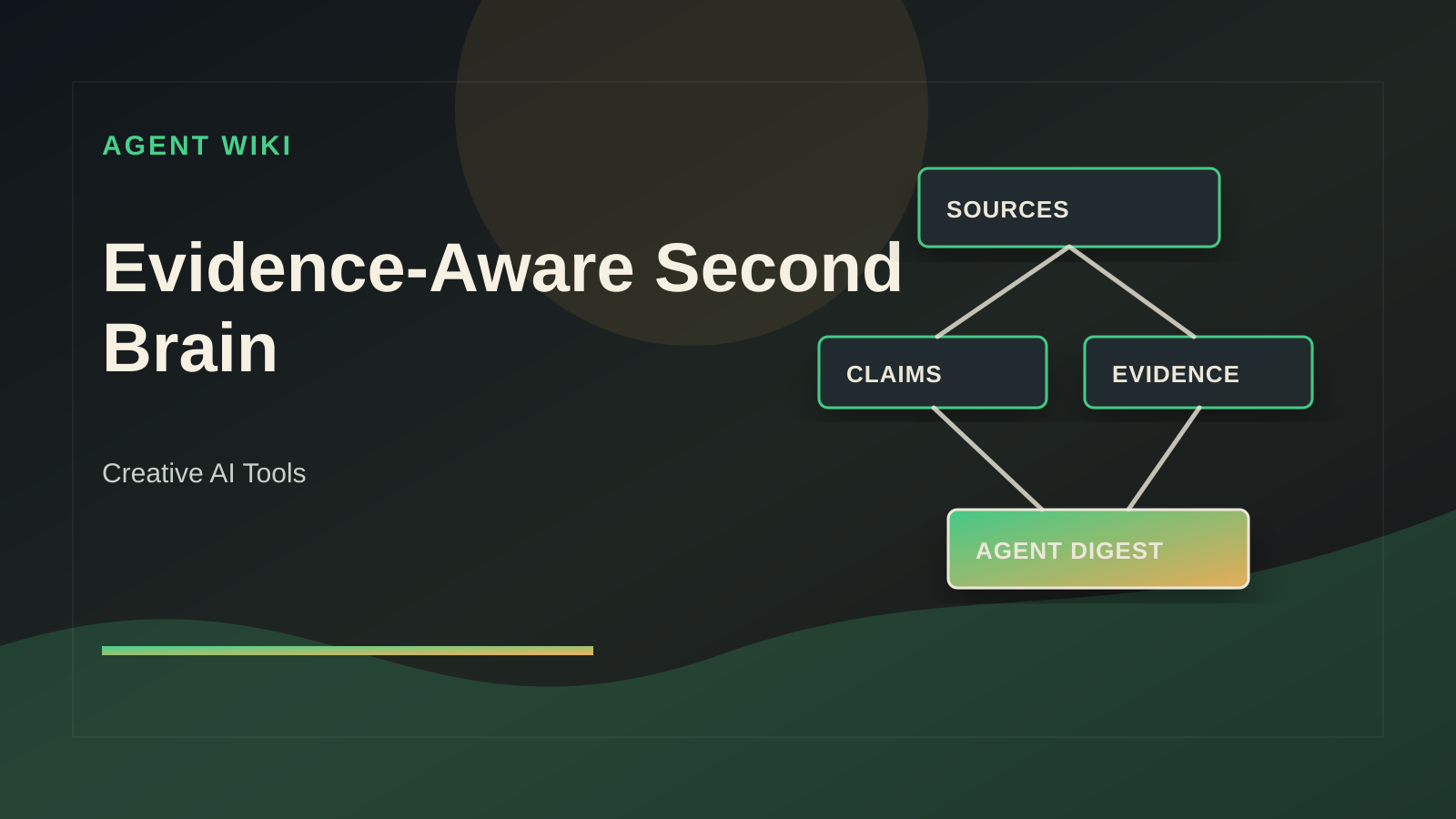
AI agents do not need more memory in the vague product-demo sense. They need maintained context they can inspect without confusing a source, a summary, a guess, and a stale belief.
That is the job of Agent Wiki: an Obsidian-compatible knowledge vault that agents can maintain without turning the whole workspace into one overconfident blob of markdown.
The important idea is not "AI notes." Notes are easy. The hard part is keeping provenance, evidence, contradictions, and open questions visible after the first summary gets written.
A second brain for agents is not a scrapbook. It is a belief system with receipts.
Why agents need durable context
Most agent workflows start with amnesia. The agent reads a repo, checks a few docs, answers a question, and then the useful context evaporates unless someone manually saves it.
That is fine for one-off tasks. It breaks down when the same agent, or a future agent, needs to keep working across weeks of research, product decisions, customer notes, transcripts, PDFs, web pages, and half-finished plans.
The usual fix is to dump everything into a folder and let retrieval sort it out later. That helps, but it does not solve the deeper problem: raw material, interpretation, and generated output are different kinds of knowledge.
If an agent cannot tell whether a sentence came from a source, a synthesis, a confident claim, a low-confidence extraction, or a contradiction report, it has context volume without context discipline.
Raw notes and summaries are not enough
A raw note is useful because it preserves what was captured. A summary is useful because it compresses what matters. A claim is useful because it can be evaluated.
Those should not be treated as the same object.
Agent Wiki separates the knowledge layer into practical primitives:
| Primitive | What it protects |
|---|---|
| Sources | Where information came from |
| Claims | What the wiki currently believes or is evaluating |
| Evidence | Why a claim is supported, challenged, or contextualized |
| Entities | The people, products, organizations, places, and named things the wiki needs to track consistently |
| Concepts | The reusable ideas, frameworks, patterns, and terms that give the knowledge base shared meaning |
| Relations | How people, products, concepts, and systems connect |
| Questions | What is still unresolved |
| Contradictions | Where the knowledge base disagrees with itself |
| Syntheses | Human-readable interpretation built from source-grounded material |
This is less glamorous than a chatbot that says it "remembers everything." It is also much closer to how serious knowledge work actually survives contact with reality.
The evidence-aware pattern
Agent Wiki's core move is simple: keep sources separate from claims, then attach evidence to the claims that depend on them.
A source page can represent a PDF, transcript, article, meeting note, web page, dataset, screenshot, or imported file. From that source, an agent can extract atomic claims, named entities, reusable concepts, relations, and open questions.
The evidence record matters because it keeps the claim honest. An excerpt can prove that a source made a statement. It does not automatically prove that the statement is true.
That distinction is where many AI knowledge systems get sloppy. They treat "the model summarized this" as if it were the same thing as "the organization knows this." Agent Wiki leaves room for confidence, freshness, unresolved questions, and conflict.
This is the Seeds of Joy principle of intellectual honesty in tool form: hold belief in proportion to evidence. The joy is not in pretending the wiki knows everything. The joy is in being closer to truth than yesterday, with enough structure to see why.
Contradictions should be surfaced, not smoothed over
Knowledge bases rot partly because people hate making disagreement visible. Agents have an even stronger temptation: they can turn conflicting material into a neat paragraph and accidentally erase the problem.
Agent Wiki treats contradictions as first-class maintenance signals. If two sources disagree on a date, definition, claim, or interpretation, the right outcome is not a prettier summary. The right outcome is a visible conflict that a human or agent can investigate later.
This is especially useful for living projects: product specs, market research, operating procedures, customer discovery, internal docs, and any workspace where the truth changes over time.
Obsidian compatibility keeps it human
Agent Wiki is markdown-first and Git-friendly. It can live as a standalone vault or inside a larger workspace. The files remain readable in ordinary tools, and the structure maps naturally to Obsidian-style knowledge work.
That matters because agent memory should not become a proprietary black box. Humans still need to inspect the sources, edit the synthesis, correct bad extractions, and decide which contradictions are real.
The folder structure is deliberately boring:
_inbox/
  raw captures waiting to be processed

sources/
  canonical source pages

claims/
entities/
concepts/
questions/
syntheses/
  maintained knowledge primitives and interpretation

_system/cache/
  regenerated machine-facing indexes
Boring is good here. A knowledge system that depends on magic is hard to debug when the agent starts making bad decisions.
Compiled caches are for agents, not humans
Humans read pages. Agents need compact, normalized context.
Agent Wiki compiles the vault into machine-facing artifacts such as page indexes, claim records, relation records, question registries, contradiction reports, timeline events, source indexes, and an agent digest.
That compilation step is important because it keeps the authored wiki and the runtime context separate. The canonical knowledge stays in markdown. The cache can be regenerated.
This gives agents a better working surface:
- Read the relevant source and synthesis pages when nuance matters.
- Use compiled indexes to find entities, claims, aliases, tags, questions, and relations quickly.
- Treat cache files as disposable build artifacts, not the place where durable knowledge lives.
That is a healthier contract than asking every future agent to reread the whole vault from scratch or trusting a pile of generated summaries as the only memory layer.
Vault mode versus workspace mode
Agent Wiki supports two practical operating modes.
Vault mode is for a dedicated knowledge vault. Material enters through an inbox, gets promoted into source pages, and original raw files can be retained separately.
Workspace mode is for projects where the wiki lives inside a larger repo or folder. The wiki can track source candidates outside its own directory while leaving the original workspace files in place. An agent then creates canonical source pages inside the wiki that point back to the original files.
That distinction is useful. A research vault and a product workspace do not want the same operating model. One is primarily a knowledge base. The other is a working project with docs, code, decisions, and research living side by side.
When Agent Wiki is worth the overhead
Agent Wiki is not necessary for every note-taking problem.
Use a simpler notes folder when the material is small, temporary, or only needs human reading. Use a normal project README when the task is just onboarding a developer. Use a lightweight task list when the only question is what happens next.
Agent Wiki starts to make sense when the cost of confusion gets high:
- Multiple sources need to be reconciled.
- Agents will revisit the same domain repeatedly.
- Claims need provenance.
- Contradictions should remain visible.
- Open questions matter.
- Generated context needs to be rebuilt instead of hand-edited.
- Humans and agents both need to read the knowledge base.
The practical test is simple: if a future agent could make a bad decision because it cannot tell source material from interpretation, you probably need more structure than a notes folder.
The operator-grade version of agent memory
The market will keep selling "memory" as if remembering more text automatically makes agents smarter. It does not.
Useful agent memory is maintained. It distinguishes evidence from belief. It admits uncertainty. It shows its sources. It keeps contradictions around long enough for someone to fix them.
Agent Wiki is pointed at that quieter, more useful problem. Not making agents sound like they remember everything, but giving them a knowledge layer worth trusting when the work gets serious.